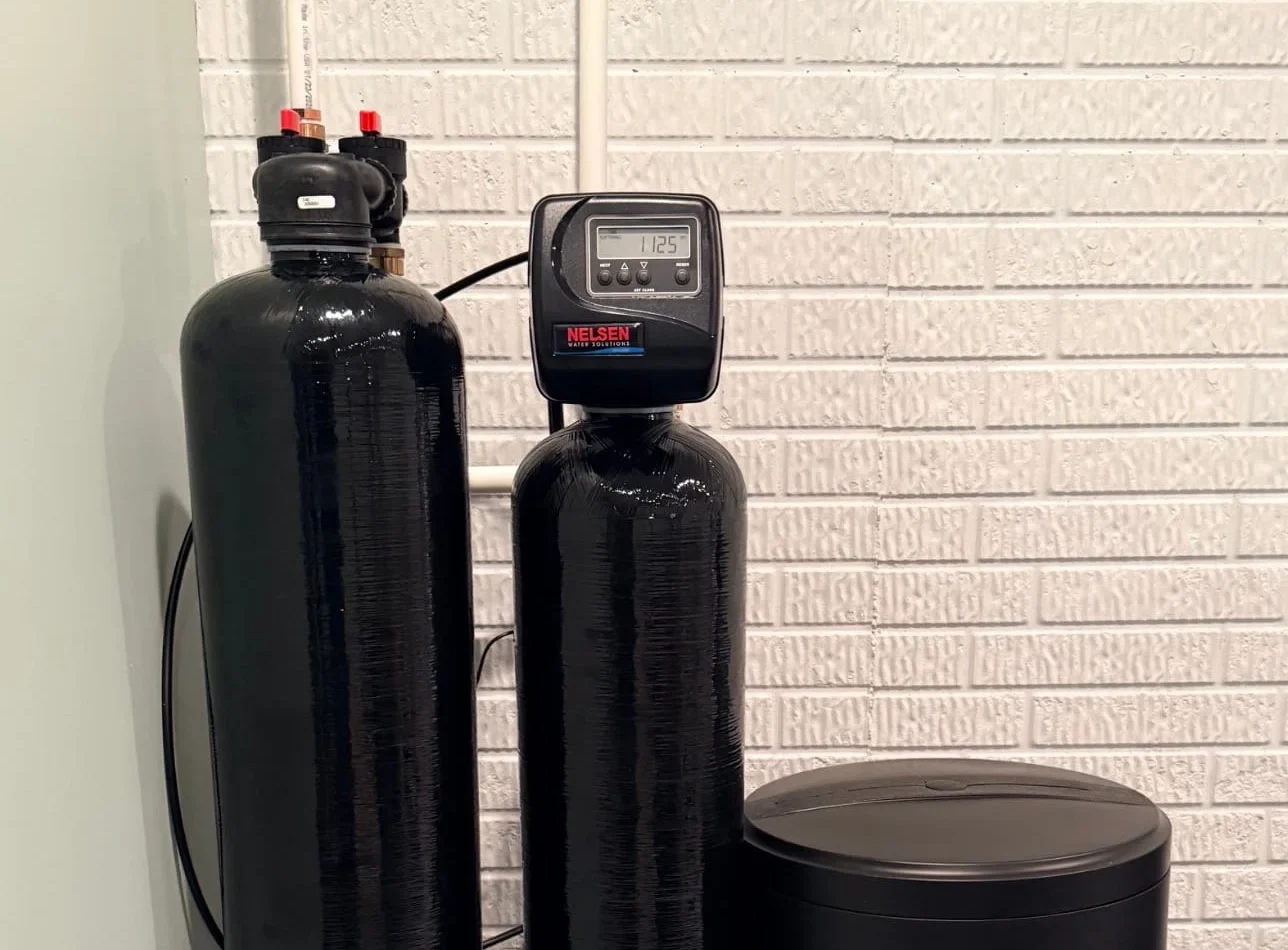
Whole house water filtration treats all of the water entering your home at a single point, so every tap, shower, and appliance runs on filtered water instead of just one faucet. A whole-house system is not a single product off a shelf. It is a set of stages built around what is actually in your water: carbon to pull out chlorine and the taste and odor that comes with it, sediment filtration to catch dirt and particles, and specialty stages for problems like iron or the rotten-egg smell of hydrogen sulfide, often paired with an under-sink reverse osmosis unit for drinking water. The right combination is decided after the water is tested, not guessed from a box. In Northwest Ohio, where well water often carries heavy iron and sulfur and city water carries chlorine, that test is what tells you which stages your home actually needs.
After years of installing and servicing these systems across the region, we can tell you the single biggest thing homeowners get wrong is picturing whole house filtration as one thing you buy, when it is really a system matched to one home’s water. Get that idea right and the rest of this makes sense.
What Most Homeowners Get Wrong
The common belief is that a whole house water filter is a single unit you pick out, plumb in, and forget. Big-box shelves and online listings reinforce it, one product, one price, as if every home’s water were the same.
Water does not work that way. City water and well water carry different problems, and two homes on the same street can test differently. A carbon filter that fixes a chlorine taste does nothing for iron staining, and a unit sized for one home can choke the water pressure in another. The reason the “one filter” idea persists is that it is easy to sell and easy to buy. The reason it disappoints is that it skips the one step that decides everything, finding out what is in the water first. That is why we test the water before we recommend a single component.
What Whole House Water Filtration Actually Is
Whole house filtration is a treatment train, a sequence of stages installed where the water line enters the home, each stage handling a specific problem. The order and the number of stages depend on whether the home runs on municipal or well water.
On municipal water, a typical build is a carbon filter, a sediment filter, and, for households that want it, softening for hardness. Carbon handles chlorine and the taste and odor that ride with it. Sediment filtration catches dirt, rust, and particles. The result is smell-free, cleaner-tasting water at every tap, along with reduction of PFAS and volatile organic compounds through the filtration stages. A home can add a point-of-use reverse osmosis system under the kitchen sink for drinking and cooking water, which pushes water through a very tight membrane and removes the large majority of dissolved contaminants, including PFAS. If you are weighing whole-house treatment against an under-sink drinking-water unit, we break that decision down in whole house filtration versus reverse osmosis.
On well water the order shifts. Sediment filtration comes first, softening second, and reverse osmosis as an optional add-on for drinking water. Wells in this region frequently need dedicated iron filtration, sulfur filtration, or both, because Northwest Ohio and Southeast Michigan are known for heavy iron and heavy sulfur. Here is where the method matters. Iron and the rotten-egg smell of hydrogen sulfide are removed by oxidizing them, turning the dissolved gas or metal into a particle a filter can trap. Some companies do that by injecting air. We do not. An air-injection system pulls whatever is floating in the surrounding air, bacteria, viruses, mold, into your water, and in our experience those tanks grow bacteria inside. We oxidize iron and sulfur with ozone, peroxide, or chlorine instead, matched to how much is in the water. It is a cleaner way to solve the same problem.
Softening is a related but separate job, it removes the calcium and magnesium that make water hard and reduces dissolved iron to a degree, and it lives in its own category rather than being a filter. What ties every one of these stages together is that each is chosen for a specific result, and the whole train is designed around the water the home actually has. If you want help matching stages to a specific problem, how to choose a whole house water filter walks through it.
What Determines Which System Your Home Needs
The variables are straightforward once the water is on the table. The first is the source: municipal water and well water start from different problem lists. The second is what the test finds, chlorine, iron, hydrogen sulfide, hardness, sediment, PFAS, or some combination. A home with only a chlorine taste on city water needs far less than a well home fighting iron, sulfur, and hardness at the same time.
The third variable is the home itself, how the plumbing runs, where the water enters, and how much water the household uses, which sets the size of the equipment. Sizing is not a detail to wave off. Undersize a system and it cuts water pressure and cannot filter thoroughly. Oversize it and you get channeling, where water carves a path straight through the media without being treated, so you pay for capacity that does not do its job. A system built to the water and the home is the one that actually works, which is the whole reason a real diagnosis comes before any recommendation.
What Happens When You Get This Wrong
When the water is not tested and the system is not matched, the failures are predictable. A wrong or wrongly sized system means weak pressure, water that still smells or stains, or filtration that never keeps up. A cheap unit bought from a big-box store or online is usually built to be replaced, not repaired, the parts often cannot be sourced, so when it fails it gets thrown away and bought again. And an air-injection system installed to save money can leave you with bacterial growth in the tank on top of the problem you were trying to solve.
We have been under a lot of houses in this region, and we have seen the aftermath, plumbing left hanging from the floor joists, three or four kinds of pipe stitched together, worn valves nobody replaced, systems that had to be pulled out and redone correctly. Redoing a job always costs more than doing it right the first time. The point is not fear, it is that the water problem is solvable, and the way you avoid the expensive version is by starting with the diagnosis instead of the box.
The Bottom Line
Whole house water filtration is not a single product, it is a system of stages built around your home’s water after that water has been tested. Understand it that way and the choices get simpler: find out what is in the water, treat the problems that are actually there, and size the whole house water filtration system to the home. The equipment matters, but so does knowing how to choose the company that installs and stands behind it, which is worth reading about in how to choose a water filtration company. If you want to know what is really in your water, the place to start is a free in-home water analysis, no guessing, no pressure, just a clear picture of what your home needs.
Frequently Asked Questions
That depends entirely on what is in your water. A home with a mild chlorine taste on city water needs much less than a well home dealing with iron, sulfur, and hardness. A water test is what answers the question honestly, before any product is on the table.
A system that is wrongly chosen or wrongly sized can cut water pressure or fail to filter well, and a cheap, unserviceable unit can end up as a throwaway. Those are avoidable problems, they come from skipping the water test and the sizing, not from whole-house filtration itself.
Filtration addresses contaminants like chlorine, sediment, iron, and sulfur, but scale comes from hardness, which is calcium and magnesium. Reducing hardness is the job of a softener, a separate step from filtration, though the two are often installed together.
The equipment is built to last many years when it is sized correctly and maintained, and the filters and media inside are replaced on a schedule that depends on the water. Keeping up with those changes is the difference between a system that lasts and one that fails early.
A properly sized system should not noticeably drop pressure. Pressure loss is usually a sign the system was undersized for the home, which is exactly why sizing to the household’s water use matters.