Toledo Water Conditioning

Home / Commercial Reverse Osmosis and Water Treatment Company

Commercial Reverse Osmosis and Water Treatment Company

Water that stops costing you equipment, sized to the load your building actually runs.

  • Est. 1947

  • 4.8★ Rating

  • Free Water Analysis

  • 35¢ Refills

Toledo Water Conditioning keeps the water in your building from costing you equipment.

A restaurant replacing its second ice machine in three years. An office building losing boiler efficiency nobody has measured. A plant needing water purer than the city delivers. Different buildings with the same root cause, and the bill always arrives as equipment rather than as water.

We treat commercial and industrial water across Northwest Ohio and Southeast Michigan, including whole-building filtration and commercial drinking water, specified to your load after the water is tested rather than oversold. Since 1947.

EVERYDAY RESULTS

Outcomes and Benefits of Commercial Water Treatment

Treated water in a commercial building shows up on the equipment ledger before it shows up anywhere else.

Boilers, heaters and dishwashers stop losing efficiency to scale.

Scale accumulates inside equipment nobody inspects, and it costs efficiency continuously and service life eventually.

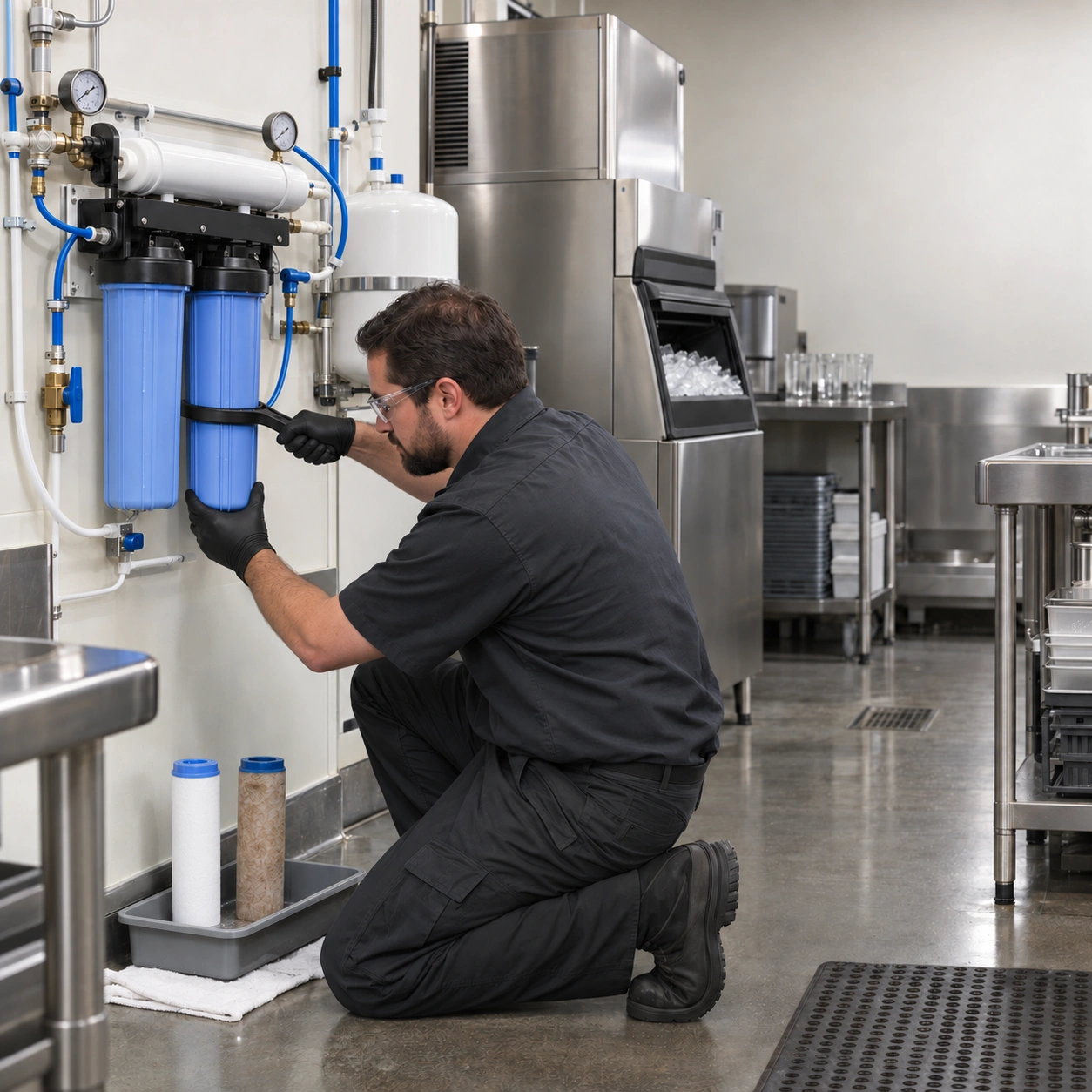
Ice machines and beverage systems stop failing early.

In food service they are the first casualties of untreated water and the most expensive to replace on short notice.

Glassware and product quality stop being a complaint.

Spotting, cloudiness and off-taste all trace back to the water rather than to the dishwasher or the recipe.

Processes that need pure water get it.

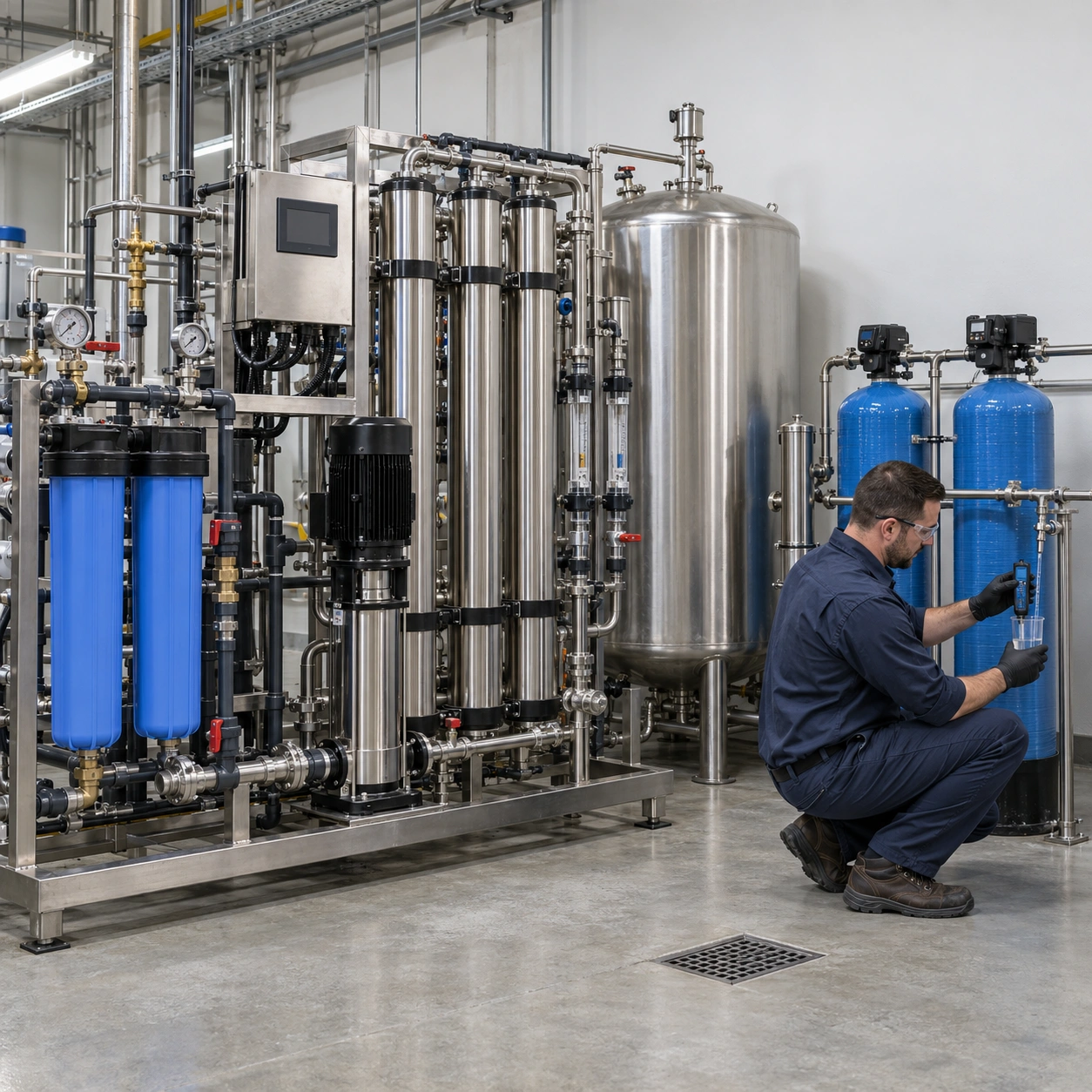
Where mineral content interferes with the work itself, deionization delivers water the process can use.

And the cost becomes predictable.

Scale is a continuous, invisible expense. Treatment converts it into a scheduled one.

Have a Question? Get in Touch!

THE INSTALLATION PROCESS

Our Commercial Reverse Osmosis and Water Treatment Process

A commercial install starts with the building, not with a catalog.

01

Facility Assessment.

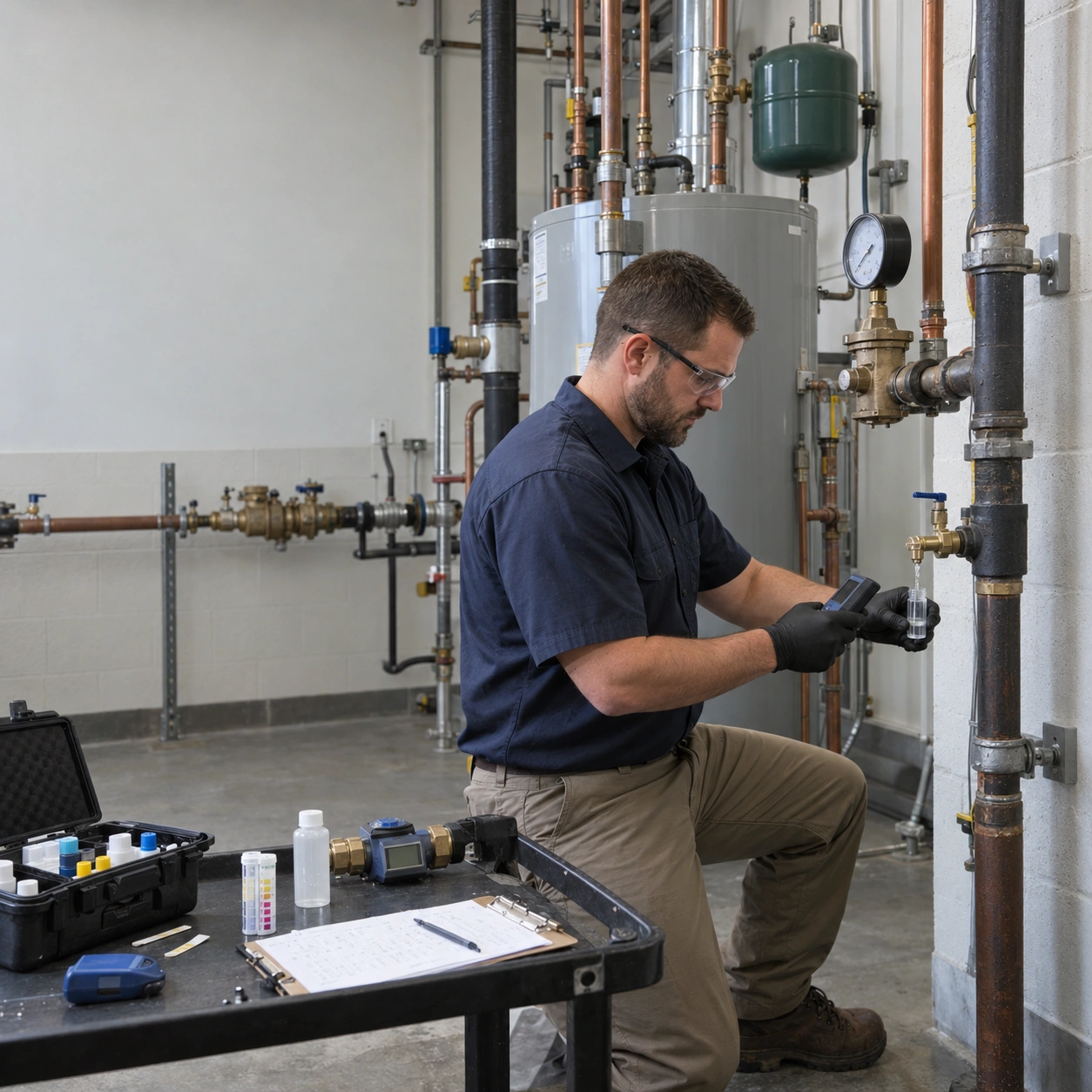
We look at what the water carries, how the building uses it, where demand peaks and which equipment is currently paying for the water quality.

02

Specification to Load.

Equipment sized to the actual demand curve rather than to square footage, with the stages ordered by what the water needs.

03

Serviceability Planning.

Where the equipment sits, how it is isolated, and whether a cartridge can be changed without shutting the building down. That is decided now, not later.

04

Installation.

Our own technicians handle the tie-in and the commissioning, scheduled around your operating hours.

05

Startup and Verification.

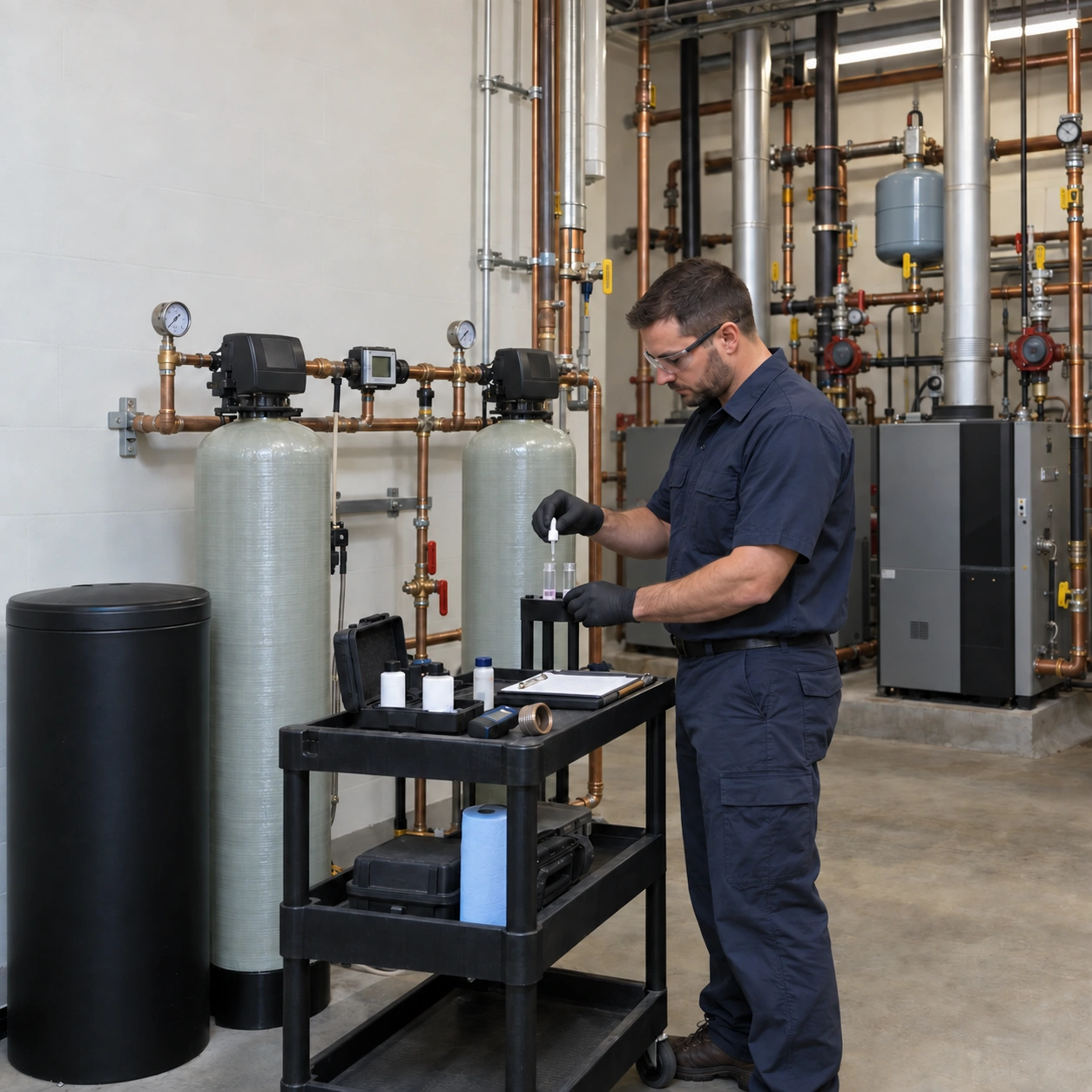
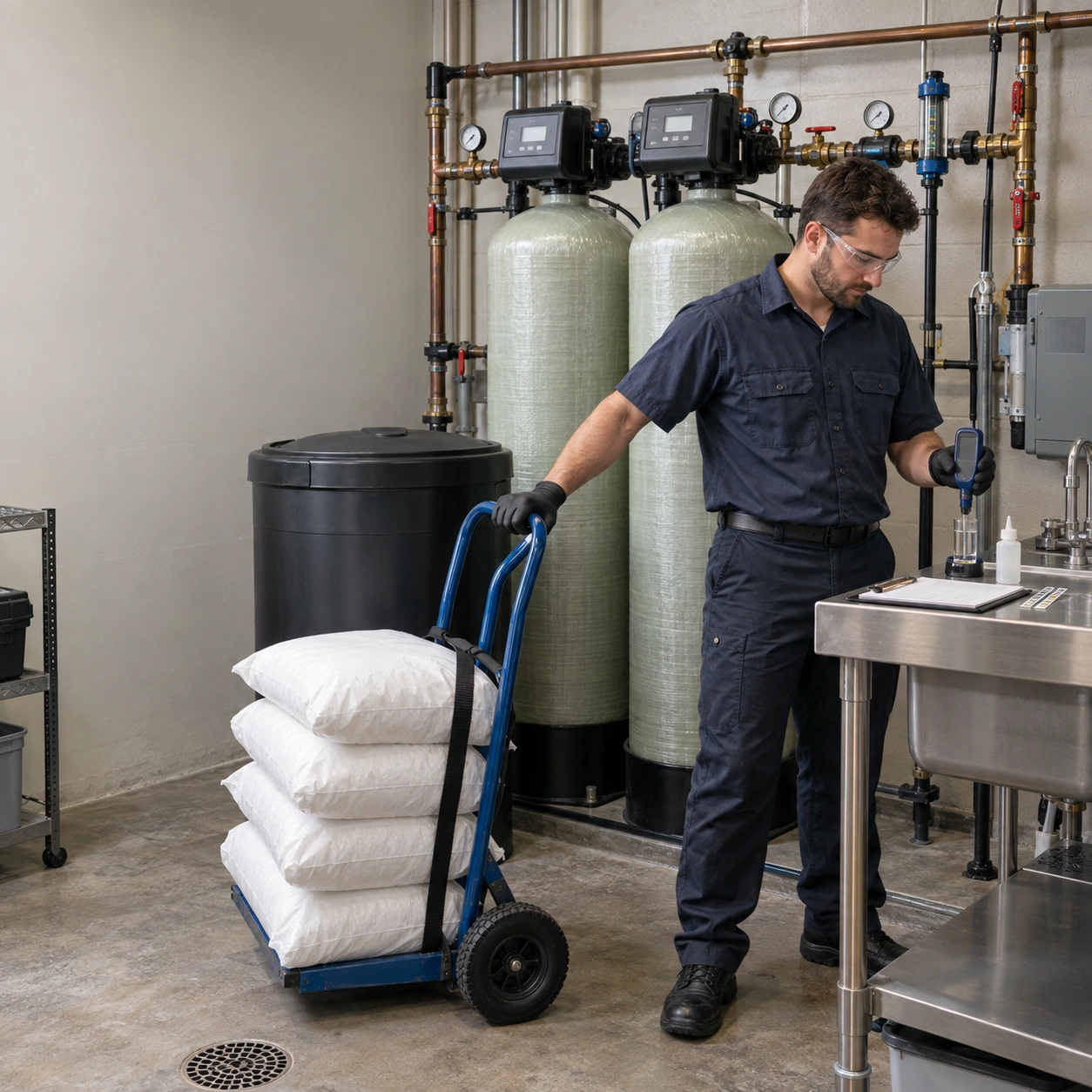
Media is backwashed and rinsed to clear fines, the control valve is programmed to the building's actual duty cycle rather than a default, and membrane permeate quality is logged before handover. Water is tested at point of use.

06

Ongoing Service and Salt Delivery.

Intervals set from the water and the volume, with delivery on a schedule you do not have to manage, and the salt carried in rather than left on the dock.

The finished result is water that protects the equipment instead of consuming it.

PRODUCTS AND MATERIALS

Commercial-Grade Systems, Specified From the Assessment

What separates a specified commercial build from a catalog quote is three things: certified media and membranes rather than generic fill, industrial control valves and skids rated for continuous duty rather than residential cycling, and capacity sized to your measured peak rather than to a nameplate. You get commercial-grade media, industrial-grade valves and our own technicians installing and maintaining them, in your facility. The difference between commercial-grade treatment and a scaled-up residential unit off a distributor shelf is duty-rated valves, certified media and a system sized to the facility’s load rather than to a catalogue size.

Hardness and scale.

Scale is the most expensive water problem in a commercial building because it accumulates inside equipment nobody looks at. Boilers, heat exchangers, dishwashers and ice machines lose efficiency as it builds and fail early because of it.

Iron and hydrogen sulfide.

Staining, odor and corrosion, removed by oxidation, which converts the dissolved iron and sulfur into particles a filter can catch. We oxidize with ozone, peroxide or chlorine rather than air injection, which brings the surrounding air into the water, bacteria and mold with it, and that is the last thing a food-service or healthcare facility needs.

Sediment, chlorine, taste and odor.

Grit that fouls valves and downstream equipment, and carbon for the rest. In food service these are not cosmetic.

Arsenic and deionization.

We treat arsenic and run deionization in house rather than referring it out. Neither is a standard build and both are specified from the test result.

Capacity is where commercial specification actually differs.

Duty cycle, peak demand and regeneration frequency come from the assessment, and equipment sized to an average load fails at the peak the building actually runs.

Capacity is matched to the facility’s peak draw and duty cycle rather than to a catalogue size, and we confirm it on-site before anything is specified. That is the difference between a system that holds through a shift and one that falls behind by mid-afternoon.

DIAGNOSE FIRST

We Assess the Facility Before We Specify Equipment

The failure mode in commercial water treatment is a vendor quoting from a spec sheet before anybody has walked the building. The equipment arrives sized for a generic load, it either underperforms at peak or costs more than the facility needed, and the service schedule was set by the brochure rather than by the water. A vendor who can quote a commercial system before assessing the facility is quoting a catalog.

We assess first, on every account. The volume, the peak demand, the process requirements and the water itself all get measured, and capacity, duty cycle and service interval come from those numbers. We treat arsenic and run deionization in house rather than referring it out, we oxidize with ozone, peroxide or chlorine rather than air injection, and our own technicians install and service the equipment.

For a facility manager, it means the proposal reflects your building rather than a category. Warranty terms on commercial equipment differ from residential and are confirmed per account, and the people who assessed the system are the people who maintain it.

WHERE IT APPLIES

Where Commercial Reverse Osmosis and Water Treatment Works Best

Commercial treatment is sized to a load rather than a household.

Restaurants replacing ice machines and steam equipment.

Scale is the usual cause, and treating the feed water is cheaper than the replacement cycle.

Buildings with boilers or cooling loops.

Efficiency loss from scale is measurable and it is rarely being measured.

Plants and labs needing water purer than the city delivers.

Deionization and reverse osmosis at a scale a residential unit cannot carry.

Not a residential system scaled up.

This is the honest limit. Commercial valves, media volume and flow rates are a different specification, not a bigger version of the same one.

Reviews

What Our Customers Say About Our Filtration Work

google

They are always very polite and professional. Would recommend them completely.

google

Always had a great experience here in deborah, made it 10 times better

google

Love this place! We started coming here a few months ago & we won't go anywhere else. Probably the best price you'll find & the water is so good!

google

Very convenient place in the Secor Gardens neighborhood.

google

Friendly and fast service.

google

Great experience with Toledo Water Conditioning! They explained all our options for water filtration in Toledo and helped us find the perfect system for our home.

google

Me and my parents get our water here and the water is so refreshing. The owner and his family are so nice. I recommend going there. If you bring your own gallon water jug it's only 35 cent to fill. Way cheaper than the store

google

Great place great people

google

We’ve been using the system for a few months now and it’s working perfectly. No issues at all.

FAQ

Frequently Asked Questions About Commercial Reverse Osmosis and Water Treatment

What kinds of businesses do you serve?

Restaurants and food service, offices, manufacturers, multi-unit and multi-family properties, and facilities with equipment that water quality affects. The build changes with what you do with the water.

What can commercial water treatment remove?

Hardness and scale, iron, hydrogen sulfide, sediment, chlorine, taste and odor, and arsenic. Deionization is available where a process needs dissolved minerals removed.

Do you handle boiler scale and equipment protection?

Yes, and it is usually the reason a facility calls. Scale accumulates inside equipment nobody inspects, and boilers, heaters, dishwashers and ice machines lose efficiency and life to it.

Can you treat arsenic?

Yes. It is not a standard build and the treatment is specified from the test result rather than assumed, so it starts with a water assessment.

What is deionization used for?

Applications where dissolved minerals interfere with the process itself rather than with taste or equipment. It produces water with the mineral content removed for that specific use.

Do you provide ongoing service and salt delivery?

Yes on commercial accounts. Service intervals and salt schedules are set from the water and the usage volume rather than a standard cadence.

Do you serve commercial accounts across the region?

Yes, across Northwest Ohio and Southeast Michigan. If you are outside that range, call and ask rather than assuming.

Will treatment actually lower our operating costs?

It changes where the money goes. Scale costs efficiency and equipment life continuously, and treatment converts that into a predictable service cost instead. Whether the arithmetic works for your building comes out of the assessment.

SERVICE AREA

Cities We Serve

Toledo Water Conditioning installs whole house water filtration and reverse osmosis drinking water systems across Northwest Ohio and Southeast Michigan, including:

Our industrial reverse osmosis service covers the cities below.

  • Toledo, OH

  • Perrysburg, OH

  • Sylvania, OH

  • Oregon, OH

  • Maumee, OH

  • Waterville, OH

Along with the surrounding communities. For commercial water treatment near you anywhere in this service area, Toledo Water Conditioning is the local company to call.

GET STARTED

Get Started With Commercial Reverse Osmosis and Water Treatment

Every system we install starts with a test of your actual water, because that is what decides the stages, the order and the size. Tell us what your water is doing and we will tell you what it needs.