Table of Contents
Why shopping for a product is the wrong start
The types of water filters a whole house system uses
What goes into a treatment train
What happens when you get this wrong
The bottom line
Frequently asked questions
Direct Answer
There is no single type of whole house water filter. There is a sequence of stages, and which stages you need depends entirely on what your water carries. A home on city water usually needs a sediment filter, a carbon filter and a softener. A home on a well usually needs sediment first, then iron and sulfur treatment where the well carries them, then softening last. The stages are not interchangeable and the order is not a preference. Which build your home gets is decided by a water test.
Key Takeaways
- There is no single filter that does everything. A whole house system is a sequence of stages, and each stage handles one problem.
- Carbon handles chlorine and taste. Sediment handles grit. Iron and sulfur need oxidation, which turns them into particles a filter can trap, not filtration alone.
- Softening is not optional on city water in this region. There is a scale for hardness, and the water here lands in the hard range: not slightly hard, not moderately, hard.
- On well water the stage order decides the outcome: sediment first, iron and sulfur next, softening last.
- Reverse osmosis is a separate point-of-use stage for drinking water, not a whole-house solution.
- The water test decides all of it. A system specified before the test is a guess with a price on it.
After decades of installing these systems across Northwest Ohio, the builds that fail early almost never fail because of the equipment. They fail because the stages were chosen before anybody knew what was in the water.
Why Shopping for a Product Is the Wrong Start
Shopping for whole house water filtration usually starts the same way: people go looking for a product. They want to know which one is best, the way you would ask which refrigerator is best.
Water treatment does not work that way. The equipment is chosen after the water is tested, not before, and two houses on the same street can need different stages if one is on a well and the other is on the city line. A filter that solves a chlorine taste does nothing for iron staining. A softener that fixes hard water does nothing for a rotten egg smell, and putting one in front of more iron than it can handle shortens its life instead of extending it.
The other common assumption is that more stages means better water. It does not. It means more equipment to maintain and more money spent on capacity the water never asked for. A house with no iron does not need an iron filter, and installing one is not thoroughness, it is waste.
The Types of Water Filters a Whole House System Uses
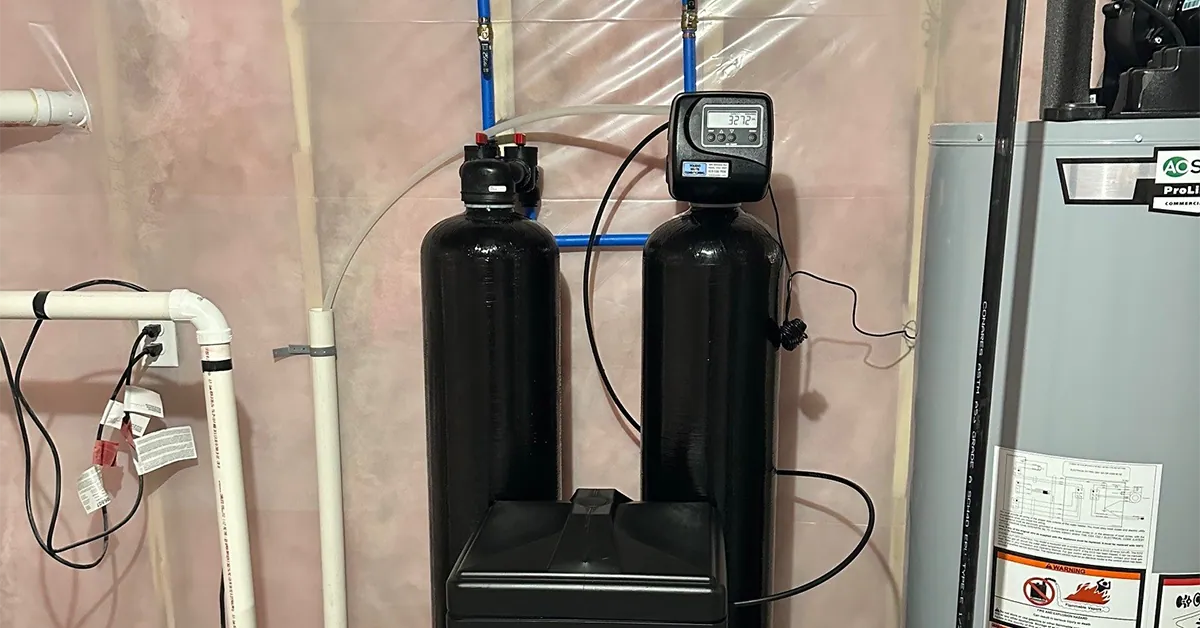
A whole house filter is not one device. It is a stage in a treatment train, installed where the water enters the house so every tap, shower and appliance gets treated water rather than just the kitchen sink.
Sediment filtration catches the physical grit: sand, silt, rust flakes, the particles you can sometimes see in a glass. It goes first for a mechanical reason. Everything downstream of it works better when it is not being fouled by material that a cheap cartridge could have caught.
Carbon filtration handles chlorine, taste, odor and many volatile organic compounds. Activated carbon holds contaminants on its surface rather than straining them out by size. That matters because the carbon fills up. The carbon does not clog and announce itself the way a sediment filter does, it just quietly stops working, which is why replacement cadence is part of choosing it.
Iron and sulfur filtration are separate stages that address separate problems, though they often appear together on well water. Catalytic carbon is common in these trains. This is the pair that gets misordered most often.
We install softening as part of nearly every city-water build here rather than as an upgrade. Softening is ion exchange, which trades the calcium and magnesium that cause scale for a small amount of sodium. What you notice is that the scale stops: no more spotting on the glasses, no more film in the shower. It is the stage most homeowners have heard of and it is almost always the last one in the sequence.
Reverse osmosis sits apart from all of these. It is point-of-use rather than point-of-entry, installed under a sink or on a basement wall for drinking water, and it is an optional addition rather than an alternative to the train above it.
What Goes Into a Treatment Train
The stages exist. What decides your build is the water test.
On city water, the usual build is a sediment filter, a carbon filter and a softener, with reverse osmosis available for drinking water. City water is treated to be safe, not to be soft. Those are two separate jobs and the plant does only the first, so nothing removes the hardness on the way to your tap. That is why the softener is not optional here the way people expect. The carbon is there for chlorine, taste and odor, and it also reduces the range of other things a municipal supply can carry.
On well water, the order is the part that gets built wrong. Sediment filtration comes first, then iron and sulfur filtration where the well carries them, then softening last, with reverse osmosis as an optional add-on.
Iron and sulfur precede softening. They are not an afterthought added at the end.
That single sentence is the difference between a system that lasts and a system that fails early. A softener will take out a small amount of dissolved ferrous iron, but fed more than it can handle it fouls its resin bed. The homeowner then has a softener that is not softening and an iron problem they thought they had solved, and the equipment that failed was the most expensive piece in the train.
The same logic runs downward. Pre-filter changes on a well system decide whether a softener reaches the twenty years it is built for. The change interval runs from monthly to every six months depending on sediment and iron load. The cheapest stage in the sequence protects the most expensive one.
What Happens When You Get This Wrong
The failure is rarely dramatic. It is usually a system that works for a while and then stops doing what it was bought for.
A softener installed in front of more iron than it can handle will soften water for a season and then start letting hardness through, because the resin has been coated by more iron than it was ever meant to see. A carbon filter left in past its capacity stops adsorbing and the chlorine taste comes back, and because nothing looks wrong, the homeowner assumes the whole system was oversold.
The other failure is buying stages the water does not need. A five-stage system on a supply that needed two is not better protected. It is three extra pieces of equipment to service, three more places for a leak, and a bill that made sense to whoever wrote it rather than to the water.
The Bottom Line
There is no best type of whole house water filter, because the stages solve different problems and the right build is the one that matches your water test. City water here typically needs sediment, carbon and softening. Well water needs sediment first, then iron and sulfur where they are present, then softening last, with reverse osmosis optional for drinking water either way.
Anyone who can tell you which system you need before testing your water is selling equipment rather than solving a problem.
Frequently Asked Questions
Sediment, carbon, iron and sulfur filtration, and softening. Sediment catches grit, carbon handles chlorine, taste and odor, iron and sulfur stages address well water problems, and softening removes hardness by ion exchange. Most homes need two or three of these rather than all of them.
No, and paying for stages your water does not need is the most common way homeowners overspend. The water test decides. A house with no iron does not need an iron filter.
Sediment first, then iron and sulfur where the well carries them, then softening last. Reverse osmosis is a separate point-of-use addition for drinking water. On city water the usual build is sediment, carbon and a softener.
Because a softener fed more iron than it can handle fouls its resin bed. Iron and sulfur precede softening, and putting the softener first turns the most expensive piece in the train into the first one to fail.
No. Whole house filtration treats every drop entering the home. Reverse osmosis is installed under a sink or on a basement wall and treats drinking water only. On well water especially, an RO membrane depends on the treatment in front of it, so the two work together rather than competing.
A water test on your actual supply. It tells you what is in the water and at what concentration, and the treatment train is then built to that rather than to a standard package.