Table of Contents
Where the job actually is
How a whole house water filter is installed, step by step
What determines how long the job takes
What happens when you get this wrong
Why how a contractor installs it matters
The bottom line
Frequently asked questions
Direct Answer
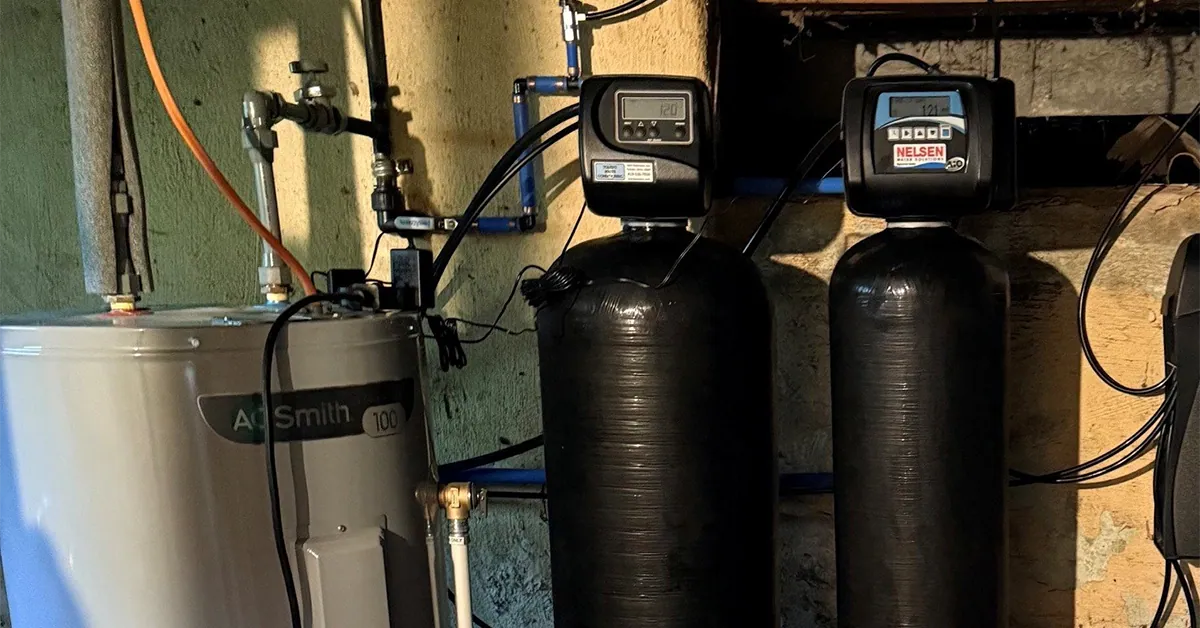
A whole house water filter is installed at the point where water enters the house, usually near the main shutoff and before the water heater. The work is a plumbing job: the main line is cut, a bypass loop and shutoff valves go in, the equipment is set and connected, a drain line is run for anything that backwashes, and the system is started up and tested. On a straightforward day it is a few hours. What decides the actual length is what the installer finds at the entry point.
Key Takeaways
- The install is mostly plumbing decisions, not equipment decisions. Where the water comes in decides the day.
- A bypass loop and isolation valves are not optional. Without them the whole house loses water every time the system is serviced.
- Drain access decides whether a location works at all, and an air gap on the drain line is a code requirement, not a preference.
- Startup matters as much as installation. Media has to be rinsed and settings programmed to the household’s actual water use.
We have come back to enough neglected systems to know that nobody was ever shown the bypass. A system nobody was taught to operate gets neglected by default, which is why the walkthrough is part of the job.
We have replaced enough systems in this region that were installed correctly and set up wrong to know the difference shows up in year two, not week one.
Where the Job Actually Is
Picture the job and you probably picture a unit being set in place. The equipment is the visible part, so it feels like the job.
The plumbing is the job. The equipment sits where the installer puts it, and where the installer puts it determines whether the system can ever be serviced, whether the house can run water when the filter is offline, and whether a leak takes out a finished basement or drips into a floor drain.
The second assumption is that the sequence is flexible, that the stages can be plumbed in whatever order fits the space. It is not flexible. Sediment comes first, then iron and sulfur where the well carries them, then softening last. Iron and sulfur precede softening. They are not added at the end.
An installer who plumbs a softener ahead of more iron than the resin can handle has built a system that will fail, and it will fail at the most expensive component. We come back to enough neglected systems in this region to know that nobody was ever shown the bypass.
How a Whole House Water Filter Is Installed, Step by Step
One, the water is tested and the entry point is assessed. This happens before anything is ordered. The test says what stages are needed and the walk-through says whether there is room to put them where they belong, whether a drain is reachable, and what the existing plumbing is made of.
Two, the main is shut off and the line is drained. Standard for any main-line work.
Three, the tie-in is cut and a bypass loop is plumbed. The bypass is the part homeowners never ask about and always need. It lets the house run unfiltered water when the system is down for service or repair, instead of the household losing water entirely because one cartridge needs changing.
Four, shutoff valves go in on both sides of the equipment. Same reason. A system you cannot isolate is a system that requires shutting off the whole house to touch.
Five, the equipment is set in sequence. Sediment, then iron and sulfur where they apply, then the softener, with the order fixed by what each stage does to the water before the next one sees it.
Six, a drain line is run. Anything that backwashes has to send that water somewhere, and it needs an air gap so nothing can siphon back into the system.
Seven, the system is started up, purged and tested. The media is rinsed, air is worked out of the lines, settings are programmed to the household’s water use and hardness, and the water is tested again at a tap to confirm the system is doing what it was specified to do.
Eight, the homeowner is shown the bypass, the shutoffs, and the maintenance interval. A system nobody was taught to operate gets neglected by default.
What Determines How Long the Job Takes
How many stages. A single filter is a shorter job than a four-stage well train. More equipment means more connections and more places to test.
What the entry point looks like. A clear wall near the main with a floor drain nearby is a straightforward install. A crowded utility corner with no drain within reach means running a line, and that is the variable that most often turns a half day into a full one.
What the existing plumbing is. Copper, PEX and galvanized each connect differently, and old galvanized sometimes cannot be cut and rethreaded without replacing a section.
Whether a drain is available. Backwashing equipment needs one. Where there is none, the options are running a line to the nearest suitable drain or relocating the equipment, and both add time.
Whether anything unexpected is behind the wall. The honest answer is that nobody knows until it is open, which is why a quote given without seeing the entry point is a guess.
What Happens When You Get This Wrong
No bypass. You lose water to the whole house every time the system needs attention. Homeowners in this position often just stop maintaining the system, which is a slower and more expensive failure.
Wrong sequence. A softener fed more iron than it can handle fouls its resin bed. You end up with a softener that no longer softens and an iron problem you thought was handled.
No air gap on the drain. A siphon path back into the equipment, which is the one installation defect that is a health question rather than a performance one.
Equipment set where it cannot be serviced. A filter housing with no clearance above it cannot have its cartridge pulled without dismantling the plumbing around it. That gets discovered at the first service call, by which point it is a rebuild rather than an adjustment.
Why How a Contractor Installs It Matters
The equipment on the invoice is available to anyone. What separates one install from another is what the installer did with the entry point they were given.
Ask whether a bypass and isolation valves are included. Ask where the drain is going and whether it has an air gap. Ask whether the sequence is set by the water test, and whether iron and sulfur are being handled before the softener rather than after it. Ask who comes back if something needs adjusting in the first month, and whether the company that installed it services what it sells.
A contractor who can answer those without hesitating has installed a lot of these. A contractor who talks only about the equipment has told you what they are selling rather than what they are doing.
The Bottom Line
Installation is a plumbing job at the point of entry, and the equipment is the easy part. The sequence is fixed by what your water carries, sediment first and softening last with iron and sulfur in between. A bypass, isolation valves and a properly gapped drain are not upgrades, they are what makes the system serviceable for the next twenty years.
The length of the job depends on what the entry point looks like, which is why it gets assessed in person rather than over the phone.
Frequently Asked Questions
A straightforward single-stage install runs one to three hours. A multi-stage well system with a drain line to run can be a full day. The number of stages and the condition of the entry point decide it.
At the point where water enters the house, near the main shutoff and ahead of the water heater, so treated water reaches every fixture and the heater is protected too.
Both skills are involved. The plumbing has to be done correctly and the sequence and settings have to match your water test, which is the part a general plumber has no reason to know.
Only while the main is off for the tie-in, not for the whole job. Once the bypass and valves are in, the house can run water while the equipment is set and started up.
A bypass lets the house run water while the system is offline for service. Yes, you need one. Without it, a cartridge change means shutting off water to the whole house.
The plumbing is within reach of an experienced DIYer. The parts that go wrong are the sequence, the drain air gap, and programming the system to your actual water, and those are the parts that determine whether it works or quietly fails.