Table of Contents
- Three beliefs that cost well owners money
- What a well water filtration system actually is
- What happens when you get this wrong
- Why how a contractor treats well water matters
- The bottom line
- Frequently asked questions
Direct Answer
If your house runs on a well, you almost certainly need treatment, and a single filter is rarely enough. Well water in Northwest Ohio and Southeast Michigan commonly carries sediment, iron and sulfur alongside hardness, and each of those needs its own stage in a specific order: sediment first, then iron and sulfur where the well carries them, then softening last. The stages come from a water test on your well, not from a package.
Key Takeaways
- A well water filtration system is a build, not a product. What goes in it comes from the test, not from a category.
- Well water in this region tends to carry iron and hydrogen sulfide, which is a different problem list from city water entirely.
- Iron and sulfur are removed by oxidation, which turns dissolved iron and sulfur into particles a filter can catch, and the oxidizer matters: ozone, peroxide or chlorine rather than air injection.
- The stage order is the single most common mistake. A softener will remove a small amount of dissolved ferrous iron, but fed more than it can handle it fouls its resin bed.
- Sizing is to household water use and hardness, not to square footage.
- Serviceable, repairable equipment is worth more over its life than a cheaper unit that gets thrown away.
We have been under a lot of houses in the townships outside Toledo cleaning up after well systems that were plumbed in the wrong order, and the softener is almost always the casualty.
Three Beliefs That Cost Well Owners Money
Start with the belief that costs the most: that a softener handles well water. It handles part of it. A softener removes hardness, and ion exchange takes a small amount of dissolved ferrous iron out along with it, which is why a light iron load sometimes needs nothing else. What a softener cannot remove is ferric iron, the red oxidized kind, or iron bacteria, and it does nothing for sulfur or sediment. In our experience the well systems that last are the ones where somebody put the stages in the right order on day one. Put a softener first in line, where it meets more iron and sulfur than it was ever built to see, and you shorten its life instead of solving anything.
The second belief is that clear water is clean water. Iron and hydrogen sulfide are both largely invisible in a glass. Iron announces itself later as orange staining on fixtures and laundry. Sulfur announces itself immediately as a rotten egg smell, and often only at the hot tap, which makes people blame the water heater.
The third is that a well is a well. Two wells a mile apart can carry completely different loads, and concentrations on the same well shift with the seasons as the water table moves. A neighbor’s system is a data point about their well, not yours.
What a Well Water Filtration System Actually Is
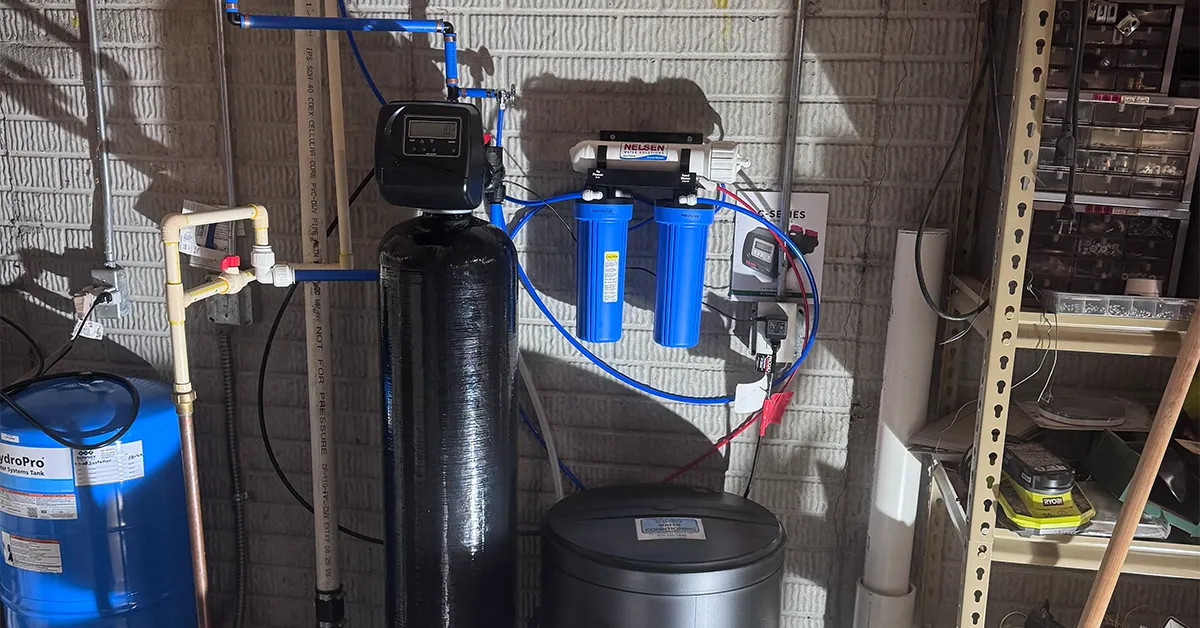
It is a sequence of stages, sized to what your well carries.
Sediment filtration goes first. Wells pull grit, sand and silt, and everything downstream works better when it is not being fouled by material a cartridge could have caught. The grit comes out first for a mechanical reason, not a preference.
Iron filtration comes next where the well carries enough iron to need it. An iron filter is not always necessary, because a softener will take a small amount of dissolved ferrous iron out on its own. It depends on how much iron is there and what form it is in. Where a filter is called for, this is the stage responsible for the orange staining, and the test is immediate: an iron test changes color instantly, not after several seconds.
Sulfur filtration handles hydrogen sulfide, the rotten egg smell. Catalytic carbon is common in these trains.
Softening comes last. Iron and sulfur precede softening. They are not an afterthought added at the end.
Reverse osmosis is an optional addition rather than part of the train, installed under a sink or on a basement wall for the water you drink. On well water especially, an RO membrane depends on the treatment in front of it. Without pre-treatment the membrane plugs and the system fails prematurely.
How the Stages Are Chosen for Your Well
A well water filtration system is not a product you pick off a shelf. It is a build, and what goes into yours is decided by a test rather than by a category. What makes a build the right one is narrower and checkable.
It was specified from a test on your well, not from a regional assumption. The test says what is present and at what concentration, and concentration decides equipment size as much as presence does.
The stages are in the right order. This is the single most common defect in a well system and the one that costs the most.
It is sized to the household’s water use, not to a box. A system that cannot keep up with peak demand delivers untreated water exactly when the house is using the most.
The pre-filters are accessible and the maintenance interval is realistic. On a well, pre-filter changes run anywhere from monthly to every six months depending on sediment and iron load, and staying on that schedule is what gets a softener to the twenty years it is built for.
And the company that sold it can service it. A well system needs adjusting as the water changes seasonally, and that is an ongoing relationship rather than a delivery.
What Happens When You Get This Wrong
A softener installed ahead of more iron than it can handle fouls its resin bed. You end up with a softener that no longer softens and an iron problem you believed was handled, and the component that failed was the most expensive one in the train.
An undersized system works during normal use and fails at peak. You get treated water most of the time and untreated water during the morning rush, which is the hardest failure to diagnose because everything looks fine when the technician tests it.
Skipped pre-filter changes push sediment and iron into equipment that was never meant to catch them. This is the failure that retires a softener years before it should have needed replacing.
An RO installed with no pre-treatment plugs its membrane and fails early, and the homeowner concludes RO does not work on well water when what actually happened is that it was installed without the train it depends on.
Why How a Contractor Treats Well Water Matters
Anyone can sell a well package. What separates one company from another is whether they know what type of iron they are dealing with and how much of it a softener can take out before a filter is needed. Ferric, ferrous and bacterial iron are three different problems and all three are treated differently. Most other companies either cannot tell the difference or do not know there is one, and that is before anybody tests the well.
Ask what the test found and at what concentration. Ask what form the iron is in, ferric, ferrous or bacterial, and how much of it the softener is expected to handle on its own. Ask what order the stages go in and why. Ask specifically whether iron and sulfur are being handled before the softener. Ask what the pre-filter interval will be on your water and who changes them. Ask what happens when the water shifts seasonally, because on a well it will.
A contractor who has an answer to all of these has treated wells in this region. A contractor who quotes a well package before testing has sold you somebody else’s well.
The Bottom Line
If you are on a well, you need treatment, and you need the stages your water test calls for in the order the water requires. Sediment first, iron and sulfur where the well carries them, softening last, and reverse osmosis optional for drinking water.
The stages are not interchangeable and the order is not negotiable. A softener alone will not fix well water, and a softener installed in front of more iron than it can handle will not last.
Frequently Asked Questions
Almost certainly. Wells in this region commonly carry sediment, iron and sulfur alongside hardness, and each needs its own stage. A water test on your well tells you which ones and at what size.
Not on its own. A softener removes hardness, and it will take a small amount of dissolved ferrous iron out with it. It does nothing for ferric iron, iron bacteria, sulfur or sediment, and installed ahead of more iron than it can handle it fouls its own resin bed.
The grit comes out first, iron and sulfur next where the well carries them, and hardness last. Reverse osmosis is a separate optional stage for drinking water. Iron and sulfur precede softening, they are not added at the end.
Often, because wells here frequently carry both. They are treated as one train rather than two purchases, and both sit ahead of the softener.
Pre-filters run from monthly to every six months depending on sediment and iron load. Staying on that interval is what gets a softener to the twenty years it is built for.
Yes, and it needs pre-treatment in front of it. Without the sediment, iron and sulfur stages handled first, the membrane plugs and the system fails early.